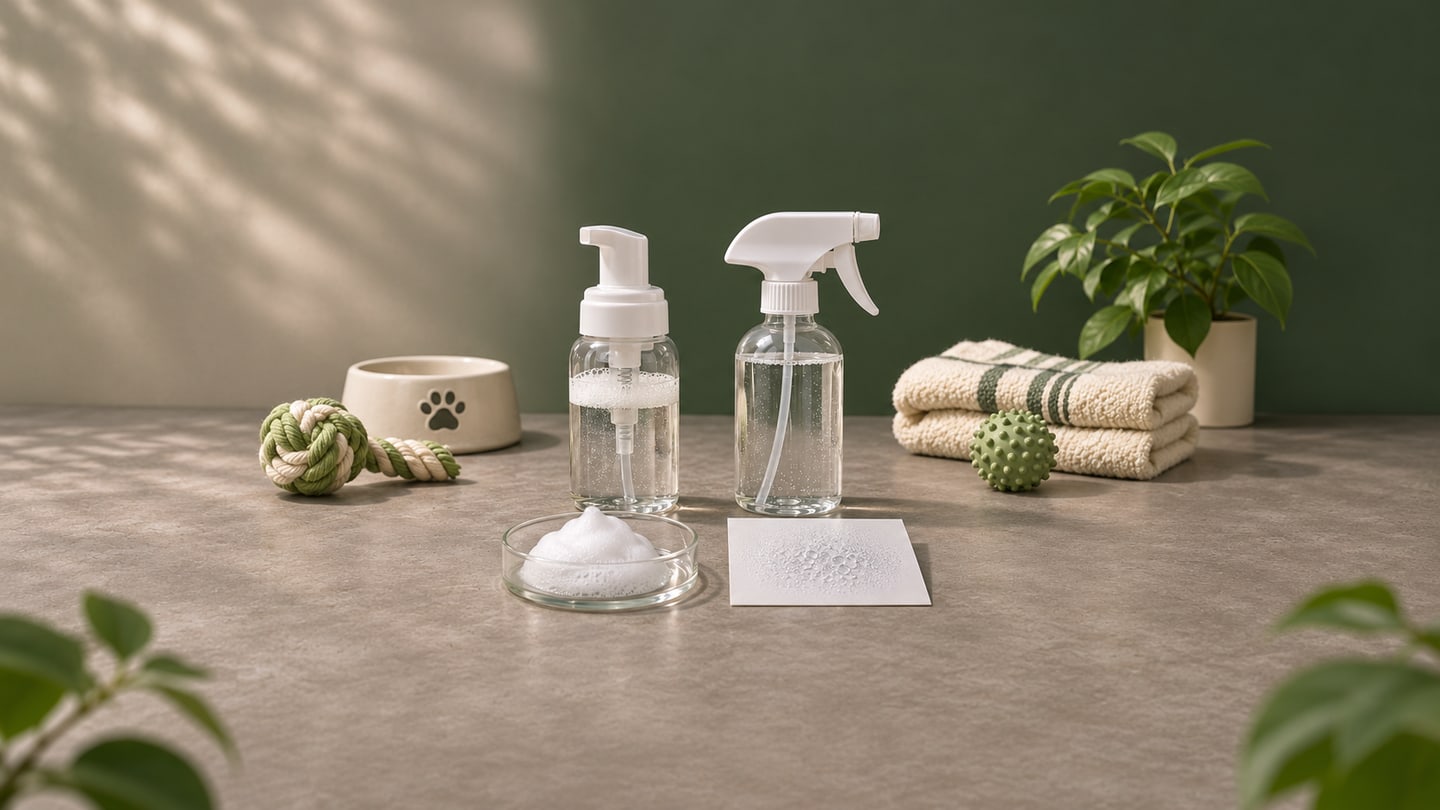
A private label waterless dog shampoo project begins with how the buyer expects it to be applied. A foamer delivers product into the hand for targeted application, while a spray can distribute liquid across a wider area. Both versions need evidence that the formula, dispenser and directions work together in the proposed use.
Define what the no-rinse product should do
Position the product around a specific use
Decide whether the SKU is for a coat refresh between baths, local cleanups, or a salon finishing routine. Describe the coat areas, expected amount and whether directions call for wiping or brushing. A product intended to remain on the coat or to be wiped away needs an exposure review that reflects remaining residue and foreseeable contact. Check the directions for application near the muzzle, eyes or other sensitive areas with the product safety reviewer.
Develop the dispenser with the formulation
A foamer pump typically mixes liquid with air through its mechanism. Formula properties and the pump design can change the consistency, dose and collapse of the foam. A spray’s actuator affects coverage, droplet pattern and repeat dosing. Compare components at the beginning of sampling so you test the intended delivery rather than a lab bottle with different output. Review the cleansing foam, cleansing spray and foam versus spray guide when choosing prototypes.
Compare foam and spray as complete products
| Criterion | Non-aerosol foamer | Pump spray |
|---|---|---|
| Application | Hand or cloth application can target a specific area | Direct or cloth application can cover a broader area, depending on reviewed directions |
| Dose and distribution | Record mass per pump and foam consistency after priming | Record mass per spray, coverage and repeatability |
| Residue and drying | Check feel after the intended wipe or brush step | Check for uneven wetting and drying at the proposed dose |
| Packaging checks | Check foamer priming, intermittent use and compatibility with the neck and cap | Check pattern, drips, closure security and use after storage |
| Commercial questions | Confirm pump supply, cap availability and replacement terms | Confirm actuator options, label space and transport conditions |
Review claims and the final use directions
Assess cleansing or freshening language alongside the finished formula, instructions and product listing. U.S. FDA guidance from March 2019 addresses products intended solely to cleanse or beautify animals. Claims to treat a condition can affect intended-use classification. For U.S. advertising, ensure objective claims have a reasonable basis before publication. FDA grooming-aids guidance · FTC substantiation policy.
Write a pass rule for the aged pack
Identify the same actuator, formula and bottle by lot or sample code. Compare performance when freshly filled and after the agreed storage conditions. Set limits with the supplier for priming strokes, delivered mass and unacceptable drips or leaks. Include a near-empty pack and document how long units sit between uses. Keep the results alongside the signed component list so a substitute actuator triggers a new review.
Practical guide to prototyping both formats
- Give the manufacturer one use case, target coat, region, pack size and launch quantity. Write one product brief for each proposed application method.
- Request a defined pump and bottle for each sample. Compare priming, mass delivered over a set of actuations, drying and residue using agreed conditions.
- Review the pack after storage and representative distribution. Ask whether formula, actuator and seal changes trigger additional checks.
- Pick the format with the clearest directions and most consistent application. Share the approved sample code and final pack through the quote inquiry form.
Frequently asked questions
General procurement questions
Can I supply my own bottle and pump?
Discuss component drawings, samples and availability. Confirm who qualifies the fit and handles changes or failures.
Can I receive more than one prototype?
Ask the supplier to specify which formula and dispenser combinations can be sampled and how each will be identified.
What should I send to get a useful quote?
Send the application method, preferred fill, target market, label scope, first-order volume and launch date.
Questions about waterless dog shampoo
Is foam or spray better for a no-rinse dog shampoo line?
Use foam when hand-applied control suits the brief. Consider spray when broad coverage matters and its reviewed directions fit the use case.
Can the same formula work in a foamer and a spray?
It may be feasible. Qualify each formula and dispenser combination for output, use experience and stability.
How do I test whether a pump delivers a consistent dose?
Weigh output over repeated actuations after priming, then repeat following agreed storage and handling conditions.
Does waterless mean the formula contains no water?
In this product category it usually describes application without a rinse. Check the actual composition before making ingredient claims.
Can one label cover both formats?
The directions and packaging may differ. Review artwork for each SKU against its own tested dosage, application and labeling requirements.
Conclusion
Decide with the finished package in hand. Choose the format that gives a repeatable dose and finish, clear directions and a reliable supply of the approved dispenser.
Discuss your OEM or ODM project with MUYE
WhatsApp: +86 15346717907 · Email: adon@oempetcaresupplier.com · Website: oempetcaresupplier.com