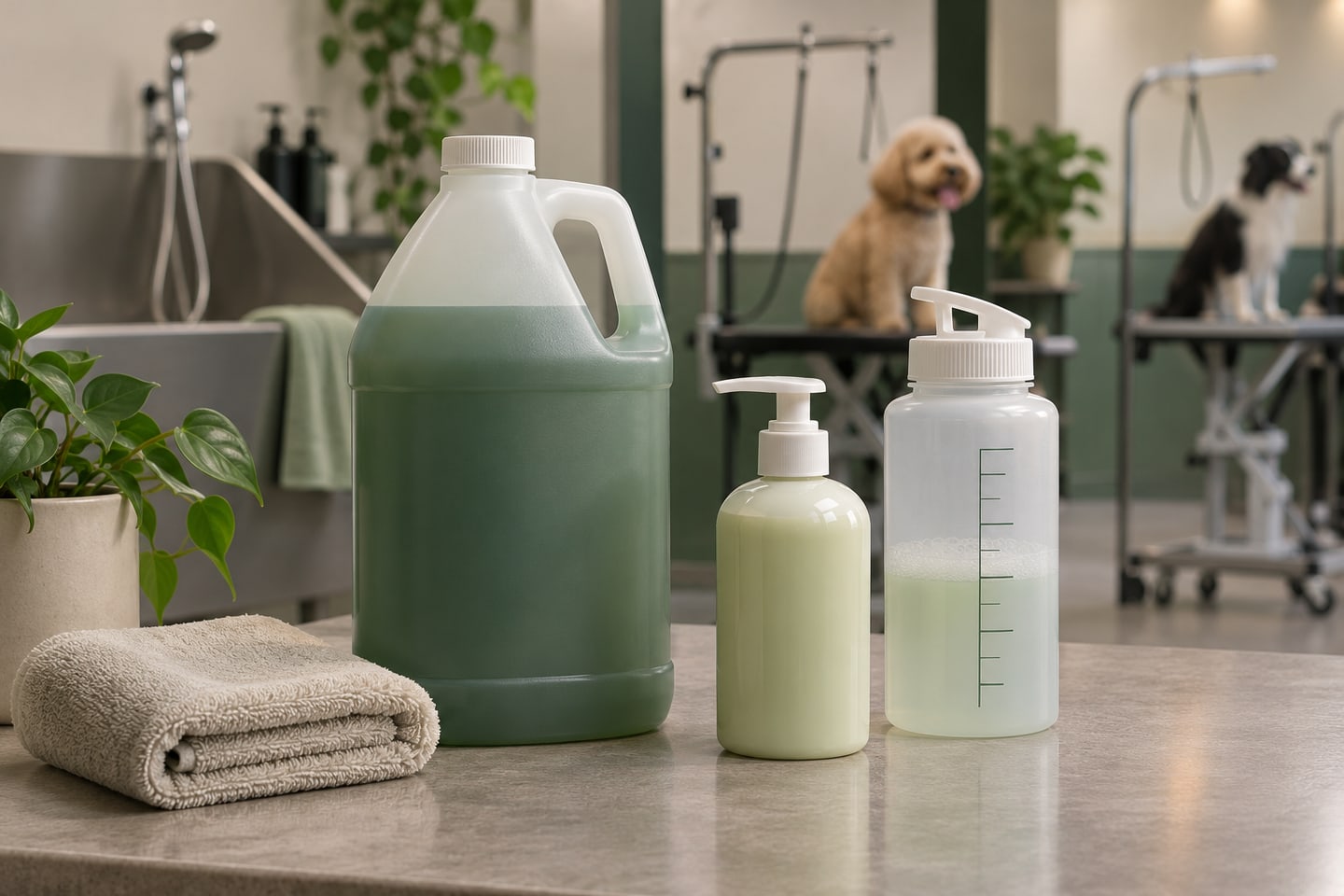
For a professional grooming salon, the useful price is the cost per usable wash. A concentrate can save storage space if staff can dose it consistently. Ready-to-use shampoo can simplify service across multiple locations. Compare both formats using actual application volumes, the time required to prepare each wash and how much product is discarded.
What differs in salon use?
Confirm what the dilution ratio means
Write directions in explicit parts of water and product. If the supplier intends 15 parts water to one part concentrate, 1 L of concentrate makes a nominal 16 L of working solution. Some ratio conventions use parts of final solution, so ask for a worked example on the specification and artwork. Set the proposed dilution, water conditions and application method for the intended coat and soil level, and use the validated directions for that product.
Review water quality, preparation and storage
Hard water and rinse practice can affect how a shampoo behaves in use. Ask for the manufacturer’s directions for dispensing, container handling, preparation and any validated holding time for diluted product. The unopened concentrate shelf life does not determine the holding time after dilution. Have the supplier explain cleaning instructions for dosing equipment and tell staff what to label on prepared dispensers. Start with the deep cleansing pet shampoo reference and pet wash catalog when specifying a proposed salon product.
Compare labor, control and cost
| Criterion | Concentrated shampoo | Ready-to-use shampoo |
|---|---|---|
| Preparation | Requires measured dilution or a compatible dosing system | Ready at the supplied strength, with a measured dispensing target |
| Consistency | Depends on dosing setup, water and staff workflow | Simplifies strength control across shifts or sites |
| Storage and freight | A smaller incoming volume can make storage and freight easier | More finished liquid travels and occupies storage space |
| Losses to include | Unused diluted solution, dosing errors and equipment handling | Bottle residuals, pump overdosing and packaging waste |
| Best procurement trial | Measure dilution accuracy and disposal across shifts | Measure actual pump output and usage by coat type |
Calculate the actual cost per wash
Suppose a 1 L concentrate costs $32 and makes 16 L at its instructed dilution. If the salon loses 10% of prepared volume, usable output is 14.4 L. At 120 mL per wash, the concentrate covers 120 washes, about $0.27 in shampoo per wash. If 1 L of ready-to-use shampoo costs $5.50 and staff use 120 mL per wash, the product cost is $0.66 at that same dose before losses. These are illustrative figures. Compare each format at its own validated use amount and add labor, consumables, transport and losses before drawing a purchasing conclusion.
Test whether the savings carry across locations
Pick sites with different service volumes and staffing patterns. Give each site the same log for product and water measured, number of washes, discarded volume, prep minutes and any service rework. Compare a high-volume and low-volume site separately before ordering one format for the chain. A concentrate that performs well at the flagship can be a poor fit in a low-volume location if staff have to discard unused prepared product. See the concentrate cost-per-bath guide for the underlying unit-cost comparison.
Practical guide to a salon purchasing trial
- Select representative coat profiles and document baseline volume and wash time. Record each location’s current dosing setup.
- Trial both formats using their own approved directions. Track volume applied, preparation time, rinse performance and amount discarded.
- Compare the cost per completed wash and stock days by salon. Set ordering units and training before rolling out to multiple locations.
- Send the use pattern, pack size and proposed order volume to the OEM/ODM project team for a production discussion.
Frequently asked questions
General procurement questions
Can I order salon and retail sizes together?
Ask if the exact same approved formula can be filled in both sizes, and request pack and filling terms for each.
What should I send when requesting a grooming shampoo quote?
Include your expected washes per week, target coat profile, desired container size, locations and order quantity.
Can a distributor run a small salon trial first?
Request a measured trial using approved samples and ask about sample quantities, timing and reorder terms.
Questions about concentrate and ready-to-use formats
What does a 15-to-1 dilution ratio mean?
Confirm the supplier’s convention. If it means 15 parts water to one part product, the nominal result is 16 parts working solution.
How long can diluted dog shampoo be stored?
Use only the holding instructions validated for that product and setup. Ask the manufacturer for the written conditions.
Does strong lather show that the ratio is correct?
Confirm the ratio using measured output. Lather can also change with water quality, soil and application method.
How can a multi-site salon check dispenser accuracy?
Use an agreed calibration procedure and record measured concentrate output after maintenance or a change in equipment or product.
When can ready-to-use shampoo be more economical?
It can be when a site uses small volumes, throws away mixed product or spends significant labor preparing and checking the concentrate.
Conclusion
Choose the format that delivers repeatable results at the lowest defensible cost per completed wash. Validate dilution, actual use volume and preparation practices before setting volumes for a salon or distributor order.
Discuss your OEM or ODM project with MUYE
WhatsApp: +86 15346717907 · Email: adon@oempetcaresupplier.com · Website: oempetcaresupplier.com